








Q&A w/ Brett King
What is The Radix about?
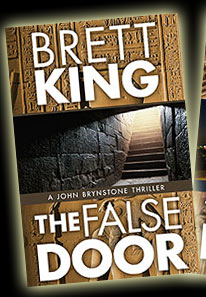
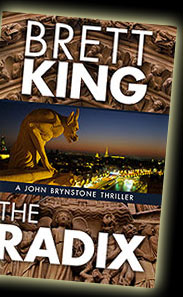
It’s about eight bucks. Buy the damned thing. You’ll make my mother very happy. The Radix tells the story of a legendary relic thought to possess powers to heal—or destroy. John Brynstone is the latest in a series of adventurers and researchers who have searched for the Radix. Across continents, Brynstone and his team must unravel riddles and ancient mysteries no one has been able to solve for five centuries. But he’s not alone in his quest. The modern-day descendents of the infamous Borgia family will stop at nothing to wield the power of the Radix. At the same time, another organization has sent a nameless assassin to kill Brynstone before he can steal their prize. The Radix will appeal to readers who enjoy a story with historical mysteries, adventure, and international suspense. The False Door, the second book in The Radix saga, is schedule for an April 2011 release.
How did you come up with the idea to write The Radix?
Many of my ideas come to life while I’m reading nonfiction and reference books. Part of the idea for The Radix came while reading the psychiatrist Carl Jung’s Psychology and Alchemy and Mysterium Coniunctionis. At the same time, I was studying Leonardo da Vinci’s sketchbooks and notebooks. Not long after that, I encountered some works on the Voynich manuscript. After flirting with ideas from each of those sources, the story evolved quickly. Originally, I had planned to feature Leonardo in the story. After Dan Brown crushed the book world with The Da Vinci Code, I scrapped that idea and went a different direction. On occasion, I’ve found ideas in science and history magazines, the Discovery Channel, and the History Channel. Some story ideas just pop out of my imagination.
What is a typical writing day like for you?
Typical? There’s no such thing for me. Basically, I write whenever I get the chance. Sometimes I wake up early and write at four in the morning. Sometimes I write after the kids go to bed. During the BC (Before Children) period of my life, I would block out big chunks of marathon writing, sometimes lasting until five in the morning. I always write best after exercise and with music. Right now, I teach four lecture courses and four online courses, so I have to work around that schedule. Along with finding time for my family and students, writing is a big priority. I crave it! Writing is like an addiction. If I go too long without writing, I can get a little cranky.
Where do you do your writing?
I write just about anywhere. My home office is the scene for most of my writing as well as a few local libraries. In the past, I have written scenes while camping in the Rocky Mountains, relaxing on beaches in the Bahamas and Southern California, riding on RTD buses in the Denver-Boulder area, waiting for a table at a restaurant, and spending lazy summer afternoons at Bryant Park in midtown Manhattan. I’ve even scratched out some stuff between innings at major league baseball games.
When you write a thriller, do you outline or do you make everything up as you
go along?
It’s changed with every book, but I now have a writing paradigm that works for me. I outline major scenes and chapters on note cards, rating them for suspense, character development, action, conflict, etc. I code each card with a different color for each character’s point-of-view. After some research, I start writing. That’s when things get interesting. Big changes play out as the story evolves. Some ideas survive edit after edit and some don’t. Detailed outlining might stifle some aspects of my creativity. I would worry if I thought I had captured the whole story in that initial outlining phase. I often end up with scenes and plot developments that I never imagined during the outset. Sometimes my characters have a mind of their own. I need to let them do what they want despite my original plans for them. Sometimes they surprise me.
What writers do you enjoy reading?
I read thrillers more than any other type of fiction. I love to read Jeffery Deaver, Lee Child, James Rollins, Steve Berry, Katherine Neville, Brad Meltzer, Clive Cussler Lincoln Child and Douglas Preston, Brad Thor, among others. Outside of thrillers, I enjoy Stephen King, Neil Gaiman, and Elmore Leonard as well as John Updike, Joyce Carol Oates, and Michael Chabon. I’ve never escaped a childhood appreciation of graphic novels. Edgar Allan Poe has intrigued me since my high school days, but Mark Twain may be my all-time favorite author. Finally, my daughter and I have burned through more My Little Pony and princess stories than I ever knew existed. Outside of fiction, I enjoy reading biographies. Books on the history of science and the history of ideas are big favorites. I’m a total geek when it comes to presidential history. If It’s well written, I’ll read about the history of almost anything—from the history of big corporations to the demise of drive-in theaters. I enjoy learning about the little moments in history as much as world-changing events. Years ago, the bulk of my reading centered on psychology and philosophy. That’s not the case now, although William James is a perennial favorite in both areas.
There are a lot of facts in your novels. Do you enjoy researching your books?
In my university lectures, I tell stories to bring the facts to life. In my fiction, I use facts to give shape to my stories. As an academician, I love the world of ideas. It goes back to my training as a psychologist. I consulted more the 200 books while writing The Radix. Only a small percentage of research actually makes it into the final edit, of course, but it’s almost always an incredible process of discovery.
Have you ever made mistakes in your research?
No matter how thorough your research, it’s inevitable that an author will make a mistake or two along the way. The big question is will anyone catch your mistake? In that respect, it’s kind of like politics. Having a reader catch a mistake in your novel is the literary equivalent of peeing your pants in the first grade. It’s embarrassing and you want to die for a minute or two, but you just deal with it and move on with your life.
Do you remember when you found out you were going to be a published
novelist for the first time?
You mean Thursday, June 18, 2009 at 2:17 in the afternoon? Yes, I do seem to remember that moment. My wonderful agent, Pam Ahearn, called me with the news. To quote Lennon and McCartney, she “spoke and I went into a dream.” Still piloting dreamy circles around Cloud Nine, I climbed in the car that night and drove to the Tattered Cover Bookstore in Highlands Ranch, Colorado to attend a signing by one of my favorite authors. In 2000, Jeffery Deaver had signed my copy of The Empty Chair at the old Tattered Cover at Cherry Creek. That night, as I gushed about his work and we discussed Gestalt therapy, I shared that I aspired to be a thriller writer. Wonderful man that he is, Jeff wrote an inspirational note that encouraged me to keep writing. His book occupied a special place on my writing desk and, during the dark times of rejection that lay ahead, I would turn to his note for inspiration. Nine years later, it was a joy to celebrate my two-book deal by attending Jeff’s book signing. I wrote him a card, brought TEC to remind him of his message, and shared my news with him. He got a far-away look in his eyes and said, “I remember the day I sold my first book.” A month later, I saw Jeff at ThrillerFest and he agreed to blurb The Radix. I’ll always remember his generosity and thoughtfulness. Maybe you can see why I’m a big-time Deaver Believer.
When did you start writing?
On a raw Friday night on February 17, 1995 (I remember these things!). I have no idea where it came from, but I sat down at our kitchen table and started writing a scene. It just spilled out of me. It was almost like an out-of-body experience. Unlike a lot of writers, I didn’t have a life-long dream of being a novelist, so it actually surprised me. The next morning, my wife discovered the notebook. When I asked what she thought, Cheri answered, “It’s not bad. You have any more?” She’s a far better typist and she encouraged me to dictate. As I paced, I came up with scene after scene for the next three hours. It was a big moment. I realized that my life was about to take a new and exciting turn.
Do you procrastinate?
I’ll answer that question later.
What motivates you to write novels?
I write to stop the nightmares. No joke. As a kid, I had night terrors (see my blog entry on “How Robinson Crusoe Made My Childhood a Living Hell”). Unfortunately, the nightmares didn’t stop in childhood. My lovely, but long-suffering wife can recount story after story about the nightmares that haunted my twenties and early thirties. When I started writing fiction, the nightmares stopped. I’ve come to realize that my twisted brain needs a creative outlet. When I don’t indulge it with storytelling, my imagination punishes me with dark dreams. From time to time over the years, I was forced to stray from writing fiction and focus on academic work. The nightmares always returned. During one period, I spent five-straight months writing a textbook and the nights were hellish. I’m writing fiction more than ever and I’m happy to report that the nightmares have stayed away for a long time. Am I normal now? God no. My dreams are a lot less interesting, but hopefully my thrillers make up for it. Aside from all the dream stuff, I write because it is, in my opinion, the greatest job in the world.
Have you ever had nightmares about any of your characters?
I’ve had dreams about John Brynstone and a few others, but only one character has given me a nightmare. He was the villain in an early, unpublished manuscript. The guy was intense and disturbing, even to me (and that’s saying something). I gave the manuscript to a student who was a police officer. She told me that after reading it, she had to sleep with the light on. She said, “Promise me you’ll write about this stuff, but never act on it.” Not long after that, I had a nightmare about the bad guy searching for me in an abandoned drive-in theater. After some debate, I shelved that manuscript and began writing The Radix. Who knows? Maybe that scary bastard will show up in one of my future novels. Just as long as he stays out of my nightmares.
Do you have a favorite bookstore?
Denver’s The Tattered Cover Bookstore gets the romance angle. They understand the seduction of books. The Tattered Cover is not just a store. It’s an experience.
What’s your favorite library and why?
Any library I’m visiting is my favorite. To paraphrase Will Rogers, I never met a library I didn’t like. I wrote major sections of The Radix in two different libraries: The College Hill Library (Westminster, Colorado) and the Mamie Dowd Library (Broomfield, Colorado). I remember a study room in the Mamie Dowd Library where my wife was gracious enough to help choreograph a fight scene. I played John Brynstone and Cheri acted out the role of Erich Metzger. Good thing the staff didn’t walk by! And, yes, it is amazing I am still married.
Do you have any pets?
I had a dog and a cat as a child, but marine fish are my thing now. I have a 125-gallon saltwater aquarium. My good friends, Tom and Vickey, own a fish store that is home to gorgeous lionfish and menacing eels. I love to look at those nasty creatures, but they’re not for me. I need calm laid-back fish. It’s way too stressful for me to own pets who eat each other. I indulge that kind of aggression in my stories, not in my home tank.
Are you related to Stephen King?
Sure. He’s my cousin. And Don King is my dad and B. B. King is my uncle. Actually, Stephen King and I both have a father named Don King (not the flashy boxing promoter, as you can probably guess). I believe Stephen King’s father changed his surname from Spansky to King, so there’s no blood connection.
You said something inside The Radix cover about lawn care. Are you really that
bad at it?
I’m not bad at it. I’m not good at it, either. I just practice responsible lawn care as little as possible. It’s a lifestyle choice.
To schedule an interview or event with Brett King,
please contact him at brettking@me.com